|
kumquat
we exoprt kumquat and fresh Fruits exporter and Vegetables from Morocco
( japanische
Orange )
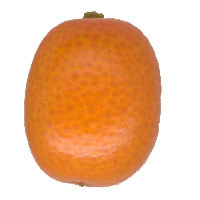

The kumquats or cumquats are a
group of small fruit-bearing trees in the subgenus Fortunella
of the genus Citrus in the flowering plant family Rutaceae,
often segregated as a separate genus Fortunella. The edible
fruit (which is also called kumquat) closely resembles that
of other Citrus but is smaller.
They are slow-growing, evergreen
shrubs or small trees, from 2.5-4.5 m tall, with dense branches,
sometimes bearing small thorns. The leaves are dark glossy
green, and the flowers pure white, similar to citrus flowers,
borne singly or clustered in the leaf-axils.
Kumquats originated in China (they
are noted in literature dating to the 12th century), and have
long been cultivated there and in Japan. They were introduced
to Europe in 1846 by Robert Fortune, collector for the London
Horticultural Society, and shortly thereafter into North America.
Originally placed in the genus Citrus, they were transferred
to the genus Fortunella in 1915, though subsequent work (Burkill
1931, Mabberley 1998) favours their return to inclusion in
Citrus.
Citrus polyandra (syn. Fortunella
polyandra) - Malayan Kumquat
Kumquats readily hybridise with other members of the genus
Citrus and with the closely related Poncirus. These hybrids
are known as Citrofortunella; examples include the limequat,
orangequat, and calamondin.
In appearance the kumquat fruit
(generally called simply "kumquat") resembles a
miniature oval orange, 3-5 cm long and 2-4 cm wide. Depending
on variety, peel color ranges from yellow to red. A Nagami
kumquat has an oval shape, while a Marumi kumquat is round.
Kumquat fruit is generally in season
from late autumn to mid-winter, and can be found in most food
markets with other produce.
|

