|
Medlar
we exoprt Medlar and fresh Fruits exporter and Vegetables from Morocco
( nèfle
, níspero , Mispel , nespola )
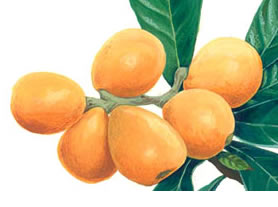

Medlar (Mespilus)
is a genus of two species of flowering plants in the subfamily
Maloideae of the family Rosaceae. One, Common Medlar Mespilus
germanica, is a long-known native of southwest Asia and possibly
also southeastern Europe, and the other, Stern's Medlar Mespilus
canescens, was recently (1990) discovered in North America.
Medlars are deciduous large shrubs
or small trees growing up to 8 m tall. The leaves are dark
green and elliptic, Medlar six to fifteen centimetres long
and three to four centimetres wide. The leaves turn a spectacular
red in autumn before falling. The five-petalled white flowers
are produced in late spring. The fruit is a pome, two to three
centimetres in diameter, with wide-spreading persistent sepals
giving a "hollow" appearance to the fruit; it is
matt brown in M. germanica and glossy red in M. canescens.
Medlar fruit are very hard and
acidic. They become edible after being softened ("bletted")
by frost, or naturally in storage given sufficient time. Once
softening begins, the skin rapidly takes a wrinkled texture
and turns dark brown, and the inside reduces to a consistency
and flavour reminiscent of apple sauce. They can then be eaten
raw, often consumed with cheese as a dessert, although they
are also used to make medlar jelly and wine. Another dish
is "medlar cheese", which is similar to lemon curd,
being made with the fruit pulp, eggs, and butter.
The medlar is native to Persia
and has an ancient history of cultivation; it was grown by
the ancient Greeks and Romans, beginning in the 2nd century
BCE. The medlar was a very popular fruit during the Victorian
era; however, it is now a rarely appreciated fruit, except
in certain areas, such as the Italian region of Piedmont and
in Iran.
The genus Eriobotrya (loquats)
is related, and sometimes called the "Japanese Medlar".
Other related genera include Crataegus (hawthorns), and Sorbus
(rowans, whitebeams, service trees).
|

