|
Quince
we exoprt Quince and fresh Fruits exporter and Vegetables from Morocco
We
are wholesale suppliers and exporters of Quince
( Coing , Quitte ,Membrillo ,Cotogna )
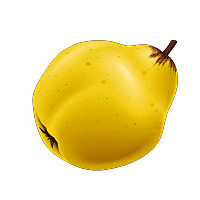

Quince is frost
hardy and requires a cold period below 7 °C to flower
properly. The tree is self fertile however yield can benefit
from cross fertilisation. The fruit can be left on the tree
to ripen further which softens the fruit to the point where
it can be eaten raw in warmer climates, but should be picked
before the first frosts.
Most varieties of quince are too
hard, astringent and sour to eat raw unless 'bletted' (softened
by frost). They are used to make jam, jelly and quince pudding,
or they may be peeled, then roasted, baked or stewed. The
fruit turns to reddish orange color once it has cooked. The
seeds are poisonous and should not be consumed. The very strong
perfume means they can be added in small quantities to apple
pies and jam to enhance the flavour. Adding a diced quince
to applesauce will enhance the taste of the applesauce with
the chunks of firmer tarter quince. The term "marmalade",
originally meaning a quince jam, derives from the Portuguese
word for this fruit marmelo (Wilson 1999). The fruit, like
so many others, can be used to make a type of wine.
Quince the quince or "membrillo" as it is called,
is cooked into a paste-like jelly and is eaten with cheese.
Quince juice from organic farming is available in Germany
and its pleasant taste mixes well with other fruit juices.
This is where the saying "A quince for you, a quince
for me, quinces we shall eat," comes from. In Lebanon,
it is called "Sfarjel" and also used to make jam.
Elsewhere in Europe, quinces
are commonly grown in central and southern areas where the
summers are sufficiently hot for the fruit to fully ripen.
They are not grown in large amounts; typically one or two
quince trees are grown in a mixed orchard with several apples
and other fruit trees. Charlemagne directed that quinces be
planted in well-stocked orchards. Quinces are mentioned for
the first time in an English text in the later 13th century,
though cultivation in England is not very successful due to
inadequate summer heat to ripen the fruit fully. They were
also introduced to the New World, but have become rare in
North America due to their susceptibility to fireblight disease
caused by the bacterium Erwinia amylovora. They are still
widely grown in Argentina, Chile and Uruguay. Almost all of
the quinces in North American specialty markets come from
Argentina. A variety of quince, which is grown in the Middle
East, does not require cooking and is often eaten raw
|

